Published - Fri, 09 Jun 2023
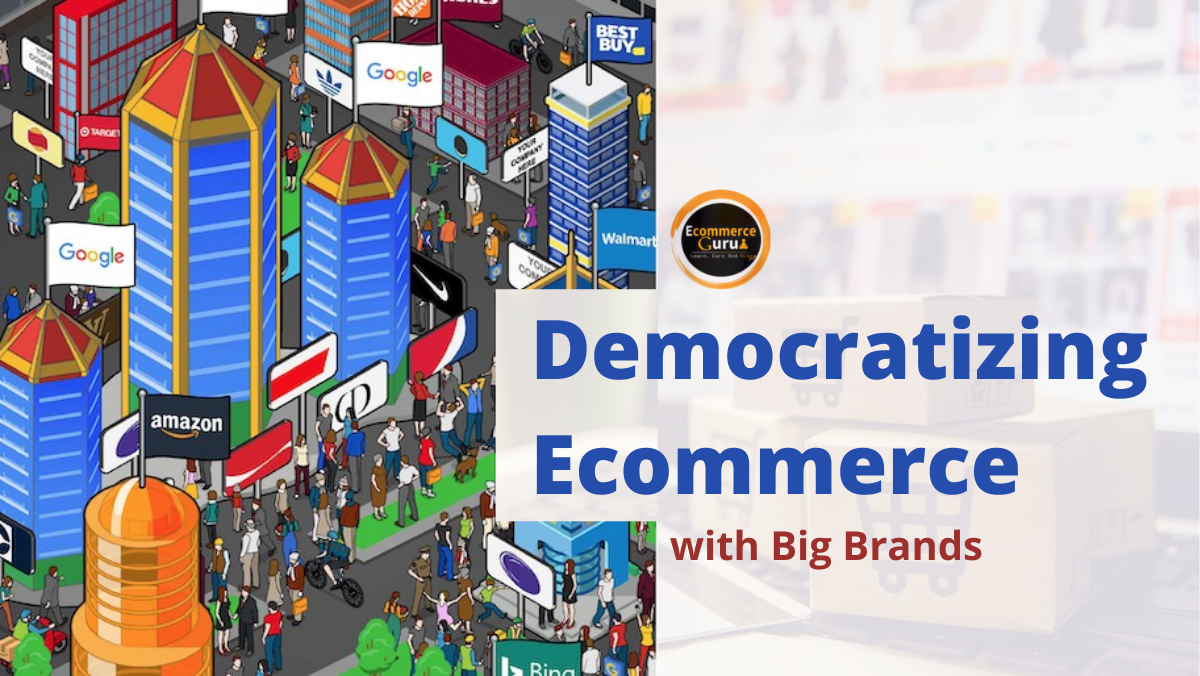
Democratizing Ecommerce with Big Brands | Ecommerce Guru
As technology advances, so is the way to retail in the economic world. Gone are the days when brick and mortar stores were a thing and retailing was not so feasible.
Indeed, it required huge costs and hassle with all these supply chains and renting expensive stores. What was then a trading world has now shifted to the ecommerce world, which basically means, a digital world making things accessible to you within a few clicks.
When we hear the word “ecommerce”, the names that often strike us are “Amazon” or “eBay.” Because these ecommerce marketplaces embraced the revolutionary phenomenon with the introduction of the internet way beyond anyone did. Ideally, this made them the big giants as they were the first ones to know the know-how and eventually became the pioneers.
Democratization of Ecommerce – Making the Internet Marketplace for everyone
Arguably, an ecommerce marketplace platform like Amazon could have created the monopoly by establishing a system that has to be followed without any question. And talking about the competition, there was no alternative for the new entrants instead of watching from the bay.
But not anymore!
With the surge in innovation and specifically keeping in terms of making ecommerce accessible to all, that is, the democratization of ecommerce, many entrants have now successfully sailed into the sea from being ashore. Business models are now adapting to the technology-first 3PL options and primarily catering to the SMEs, which has directly embedded the scaling down of the barriers.
Amazon As The Foremost Internet Marketplaces
Since 2013, Amazon has been the prominent ecommerce marketplace platform revolutionizing its way into the sphere. The post-pandemic world has given more space to it. The platform has captured most of the available growth opportunities as there is an absence of serious competition. Its capital investments, unique ecommerce strategy for services like 2-day delivery, and selling every product category are something that no other ecommerce platform can match.
Until recently, no other brand tried to dive in with this revolutionary approach for whatsoever reason, which of course, has now made it somewhat challenging to cope with. Perhaps, the path taken by Amazon has resulted in not so favorable outcomes for the sellers and retailers.
- One can witness false advertising and often scams over the platform, which is apparent from the fierce price competition. This also delves into the problems with quality control.
- To drive the prices to a lower extent, Amazon leverages the immense demand against the retailers, which, most of the time, incurs a not-so-profitable step. Moreover, sellers cannot do anything about this except following these terms.
- Amazon, being an aggregator, is not much focused on the incentives that a seller might receive by selling its products unless the purchase is through Amazon itself.
Nevertheless, with the emergence of new entrants like Shopify or BigCommerce, Amazon has been forged to induce some changes for the better of the merchants as well as the buyers.
The surge of tech-enabled, human-centric fulfillment amid the ecommerce revolution
Traditionally, eminent sellers were more entangled with spending hundreds of thousands for setting up a website, settling for a site design and integration, which obviously wasn’t preferred by most merchants. With the influx of democratization into the ecommerce world, the small merchants can now pay a small fraction of expending for their ecommerce business and hosting a professional website.
Nevertheless, the emergence of ecommerce and its democratization has resulted in us witnessing direct-to-consumer (D2C) business models for retailers. The ecommerce businesses now have access to directly connecting with their audiences. Platforms like Shopify, Magento, WordPress, and others developed as a more simplistic form of infrastructure for retailers’ utmost convenience. They now have the liberty to trade online by paying a minimal amount of $21 or whatsoever or even accessing the free trial to check the compatibility of these ecommerce marketplaces.
Shopify
Shopify has been successful at cutting out the competition by luring more retailers to start their journey with them. The Shopify website development ecommerce platform adds its value by extracting the friction out of an ecommerce business and ensuring a smooth experience for the customers. It provides a basic business model – Ecommerce solutions and Shopify payments in the form of Subscriptions and services.
By perfecting its core functions, the Shopify ecommerce platform has explored new avenues for growth:
- Shopify Fulfillment Network (SFN) – a distribution and logistics service for order fulfillment
- Stripe Balance used in Shopify Balance – to embed a full suite of services related to banking
- Collaboration with Tik Tok – to add your brand’s TikTok on the dashboard
Google has also sprinted in the zest of e-democracy to make “free” Google shopping results viewed on its primary search results. Earlier, only paid advertising was shown on the mainline search outcomes, which typically meant only the brand willing to pay more could showcase their products. This was not doing justice to the brands that were relevant to consumers’ search queries and were out shadowed by paid advertising. The democratizing strategy has impacted the brands and retailers in different ways:
- Brands will have the opportunity to get access to more visibility and free traffic from Google.
- There will be massive competition among the sellers for the visibility of listings.
- This will allow more focus on high-quality product feed which means only the quality of the product will define the brand’s success.
To Conclude:
To learn what is democracy, focusing on the key aspects which are leading a retailer to confine within an ecommerce business model becomes significant. To be more precise, there should be more liberation offered to a brand or retailer to do more than just survive in this ecommerce world. There should be more casualty to choose among the best compatible ecommerce marketplace to run your ecommerce business. And relying on just one internet platform is not a solution to it.
Created by

Comments (0)
Search
Popular categories
Ecommerce Trends
239Business
54Marketing
37Website
23Social Media
22Courses
21Latest blogs

The Power of Email Marketing in eCommerce
Fri, 15 Mar 2024

Tips for Optimizing Product Pages for Conversions
Thu, 14 Mar 2024
Mastering SEO for eCommerce Websites
Wed, 13 Mar 2024
Write a public review